The GOOSE framework ensures that systematic learning is integrated into every stage of the product process. This approach guarantees that team decisions are based on validated knowledge, not mere assumptions. Although we are constantly making “educated guesses” about the future, the aim is for these guesses to be as fact-based as possible. Crucially, every decision and experiment must be designed to advance learning, providing new insights that enable us to educate ourselves further and make better, more informed bets in the subsequent cycle.
The clearing the fog principle
The continuous learning loop is designed to systematically remove the fog of uncertainty that plagues product development. Research at each stage acts as a specific feedback mechanism:
- Strategic layers (product strategy and goals) clear the fog around “where we’re going.”
- Discovery layers (outcomes and opportunities) clear the fog around “what problem to solve.”
- Delivery layers (solutions and experiments) clear the fog around “how to build it” and “did it work.”
This iterative process turns risk into knowledge, ensuring resources are only committed when the path ahead is clear enough.
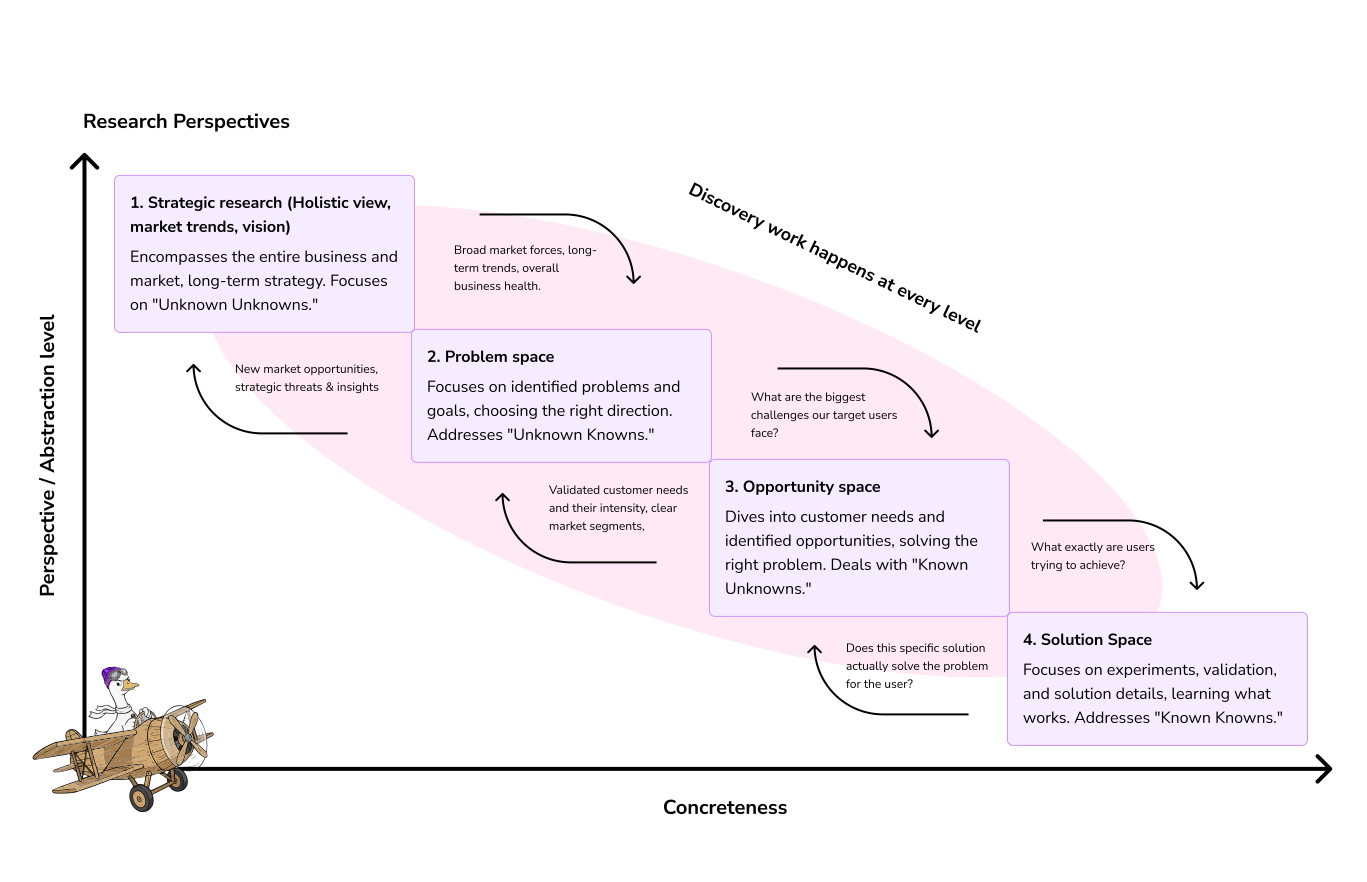
The Unknown Unknowns represent things we do not know, and we are not even aware that we do not know them. These are entirely unexpected factors that can transform industries or create new paradigms. Within the Strategic or Visionary Perspective, discovery takes the form of exploration and sensing: scanning for weak signals, emerging behaviors, or technological shifts that may reshape the environment. Even though these factors cannot be directly researched in a traditional sense, teams can foster awareness through creative foresight, trend analysis, and speculative design. Discovery here means expanding perception beyond the visible horizon.
The Unknown Knowns are things that exist as knowledge somewhere (within the organization, the market, or the ecosystem) but that we haven’t yet recognized, connected, or understood ourselves. In the Problem Space, discovery is about revealing what’s already there but hidden: uncovering latent user needs, reframing existing data, and connecting insights across silos. Teams here conduct qualitative research, interviews, and analysis to surface implicit knowledge and identify overlooked relationships. Discovery in this layer is about making the invisible visible.
The Known Unknowns describe the gaps we have already identified: the things we know we don’t know. These are uncertainties that can be deliberately researched, measured, and validated. Within the Opportunity Space, discovery focuses on defining and sizing opportunities, quantifying user problems, and testing hypotheses. Here, teams translate assumptions into structured research questions, gather evidence, and evaluate potential directions. Discovery at this level is analytical: it turns curiosity into actionable knowledge.
Finally, the Known Knowns are the things we both know and are aware that we know: validated facts, confirmed results, and proven practices. In the Solution Space, discovery is continuous but highly practical: teams learn through experiments, usability tests, and performance measurements. Even when the goal is implementation, discovery still happens as incremental learning: every iteration validates or challenges prior assumptions. Discovery here transforms knowledge into confidence, ensuring that each confirmed result strengthens the foundation for future exploration.
Across all these layers, discovery is not a phase but a mindset. It connects strategy, research, and execution, ensuring that learning happens everywhere, from visionary thinking to hands-on testing.
The insight log
The insight log serves as the collective memory and learning system for the GOOSE cycle. It maintains a perpetual research → insight loop across all phases, ensuring that knowledge gained at one stage informs the next.
Product strategy (generative learning)
- Research focus: To analyze the market at both macro and micro levels, define the Ideal Customer Profile, validate business model assumptions, size opportunities, and assess the competitive landscape to guide strategic decisions.
- Discovery question: Whose problems should we solve? How will the chosen strategy ensure long-term profitability?
Goals: choose the right direction (strategic learning)
- Research focus: To validate strategic assumptions, ensure alignment with market realities, and understand competitive positioning.
- Discovery question: Does this goal reflect real market opportunities, and are our core strategic hypotheses valid?
Outcomes: measure progress (diagnostic learning)
- Research focus: Data analysis, RARRA bottleneck review, customer journey audit.
- Discovery question: Which metric, if changed, will provide the greatest leverage toward the goal? What does success look like?
Opportunities: solve the right problem (customer learning)
- Research focus: Qualitative interviews (JTBD), customer motivational goal (mental model), quantitative scope.
- Discovery question: Why aren’t customers achieving the outcome? What is the customer’s underlying motivational goal behind this problem?
Solutions: choose the right response (risk-reducing learning)
- Research focus: Usability testing (with prototypes), technical proof of concept (PoC).
- Discovery question: Is this solution desirable? Can our team build it (feasible)?
Experiments: learn what works (validating learning)
- Research focus: A/B testing, targeted pilot releases, proxy metrics.
- Discovery question: Did the delivered solution successfully resolve the opportunity in a way that measurably shifted the outcome metric?